Wednesday, January 31, 2018

A Man Called Ove

A Man Called Ove. Fredrik Backman. Atria Books. August 2012. 337 pages.  Source: Audio library book.

First sentence: Ove is fifty-nine. He drives a Saab.

Plot: A grumpy yet loveable man finds his solitary world turned on its head when a boisterous young family moves in next door.


Meet Ove. He's a curmudgeon, the kind of man who points at people he dislikes as if they were burglars caught outside his bedroom window. He has staunch principles, strict routines, and a short fuse. People call him the bitter neighbor from hell, but must Ove be bitter just because he doesn't walk around with a smile plastered to his face all the time?

Behind the cranky exterior there is a story and a sadness. So when one November morning a chatty young couple with two chatty young daughters move in next door and accidentally flatten Ove's mailbox, it is the lead-in to a comical and heartwarming tale of unkempt cats, unexpected friendship, and the ancient art of backing up a U-Haul. All of which will change one cranky old man and a local residents' association to their very foundations. (Goodreads)

My thoughts: When I first started this book I wondered why in the world everyone would be all up in arms about this cranky old man!  The more I read the more I felt it had a similar feel to his book "My grandmother wanted me to tell you she's sorry".  It too had a sort of depressing feel about most of the book and then the end surprised you.

This story kept going from current day events to events in Ove's past.  Sometimes so quickly it took me off guard as to what was going on.  But I soon got the feel and flow of the story.  Ove is a very lonely man since his wife Sonya passed away.  So lonely in fact he had tried to commit suicide on countless occasions.  There was always someone there to interfere with his plans.  The ending left me feeling very warm and after all, happy to have read this one!

Tuesday, January 30, 2018

Back to the Classics Challenge 2018!

Going to join Karen again this year.  It's been a couple years since I tried this one.  I have yet to complete this challenge.  Hope this year is different.   You can find my selection for each category here.

Go visit Karen to get the rest of the rules...

Here's how it works:


The challenge will be exactly the same as last year, 12 classic books, but with slightly different categories. You do not have to read all 12 books to participate in this challenge!

  • Complete six categories, and you get one entry in the drawing
  • Complete nine categories, and you get two entries in the drawing
  • Complete all twelve categories, and you get three entries in the drawing


And here are the categories for the 2018 Back to the Classics Challenge:

1.  A 19th century classic - any book published between 1800 and 1899.

2.  A 20th century classic - any book published between 1900 and 1968. Just like last year, all books MUST have been published at least 50 years ago to qualify. The only exception is books written at least 50 years ago, but published later, such as posthumous publications.

3.  A classic by a woman author

4.  A classic in translation.  Any book originally written published in a language other than your native language. Feel free to read the book in your language or the original language. (You can also read books in translation for any of the other categories). Modern translations are acceptable as long as the original work fits the guidelines for publications as explained in the challenge rules.

5. A children's classic. Indulge your inner child and read that classic that you somehow missed years ago. Short stories are fine, but it must be a complete volume. Young adult and picture books don't count!

6.  A classic crime story, fiction or non-fiction. This can be a true crime story, mystery, detective novel, spy novel, etc., as long as a crime is an integral part of the story and it was published at least 50 years ago. Examples include The 39 Steps, Strangers on a Train, In Cold Blood, The Murder of Roger Ackroyd, etc.  The Haycraft-Queen Cornerstones list is an excellent source for suggestions. 

7. A classic travel or journey narrative, fiction or non-fiction. The journey itself must be the major plot point -- not just the destination. Good examples include The Hobbit, Around the World in 80 Days, Unbeaten Tracks in Japan, Kon-Tiki, Travels with Charley, etc. 

8. A classic with a single-word title. No articles please! Proper names are fine -- Emma, Germinal, Middlemarch, Kidnapped, etc.

9. A classic with a color in the title. The Woman in White; Anne of Green Gables; The Red and the Black, and so on. (Silver, gold, etc. are acceptable. Basically, if it's a color in a Crayola box of crayons, it's fine!)

10. A classic by an author that's new to you. Choose an author you've never read before.

11. A classic that scares you. Is there a classic you've been putting off forever? A really long book which intimidates you because of its sheer length? Now's the time to read it, and hopefully you'll be pleasantly surprised!

12. Re-read a favorite classic. Like me, you probably have a lot of favorites -- choose one and read it again, then tell us why you love it so much. 

Sunday, January 28, 2018

I Heard The Owl Call My Name

I Heard The Owl Call My Name. Margaret Craven. January 1980 (first published in 1967) Laurel. 159 pages. Source: Betterworldbooks.com

First sentence: He stood at the wheel, watching the current stream, and the bald eagles fishing for herring that waited until the boat was almost upon them to lift, to drop the instance it had passed.

Plot: Amid the grandeur of the remote Pacific Northwest stands Kingcome, a village so ancient that, according to Kwakiutl myth, it was founded by the two brothers left on earth after the great flood. The Native Americans who still live there call it Quee, a place of such incredible natural richness that hunting and fishing remain primary food sources. 


But the old culture of totems and potlatch is being replaces by a new culture of prefab housing and alcoholism. Kingcome's younger generation is disenchanted and alienated from its heritage. And now, coming upriver is a young vicar, Mark Brian, on a journey of discovery that can teach him—and us—about life, death, and the transforming power of love.


My thoughts: The cover of this book actually drew me in however this isn't the version that I actually read.  A white man, a vicar, goes to live among the Natives.  He has a lot to learn of their customs/traditions but he does well.  The Natives send their children to the white man schools to be educated.  They are quickly forgetting their native tongue and the old stories.  They are "Americanized" if you will.  It's really kind of sad to see this happening.

Mark, the vicar, finds himself letting go of the white mans traditions and ways of thinking.  He can see the changes coming in the tribes he serves and it saddens him.  It didn't have the ending that I expected but it was a good one nevertheless.  

Friday, January 26, 2018

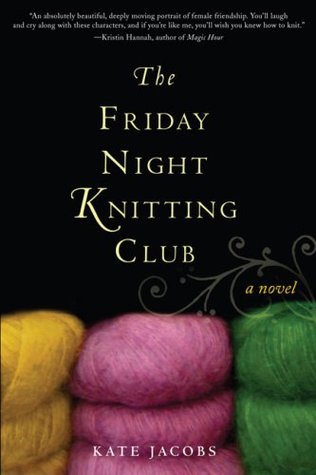
The Friday Night Knitting Club

The Friday Night Knitting Club. Kate Jacobs. 2007. G.P. Putnam's Sons. 352 pages. Source: Audio library book.

First sentence: Choosing your wool is dizzying with potential: the waves of colors and textures tempt with visions of a sweater or cap (and all the accompanying compliments you hope to receive) but don't reveal the hard work required to get there.

Plot: Once a week, an eclectic group of women comes together at a New York City yarn shop to work on their latest projects - and share the stories of their lives...

At the center of Walker and Daughter is the shop's owner, Georgia, who is overwhelmed with juggling the store and single-handedly raising her teenage daughter. Happy to escape the demands of her life, she looks forward to her Friday Night Knitting Club, where she and her friends - Anita, Peri, Darwin, Lucie, and K.C. - exchange knitting tips, jokes, and their deepest secrets. But when the man who once broke Georgia's heart suddenly shows up, demanding a role in their daughter's life, her world is shattered.

Luckily, Georgia's friends are there for encouragement, sharing their own tales of intimacy, heartbreak, and miracle making. And when the unthinkable happens, these women will discover that what they've created isn't just a knitting club; its a sisterhood.

My thoughts:  Not what I expected at all.  A group of women, most of them vitual strangers, come together to knit on Friday nights and soon develop deep friendships.  Each woman has her issues but knitting gives them a sense of peace.  Yes, I must agree it does once you get the hang of it.

It turns out that I liked this book a lot despite some very strong language (not a lot just a few here and there) and if I come across anymore in the series via audio book I will check it out.

Saturday, January 20, 2018

The Old Man and The Sea

The Old Man And The Sea. Ernest Hemingway. 1952. Charles Scribner's Sons. 132 pages. Source (purchased Betterworldbooks.com)

First sentence: He was an old man that fished alone in a skiff in the Gulf Stream and he had gone eighty-four days now without taking a fish.

Plot: It is the story of an old Cuban fisherman and his supreme ordeal: a relentless, agonizing battle with a giant marlin far out in the Gulf Stream. Using the simple, powerful language of a fable, Hemingway takes the timeless themes of courage in the face of defeat and personal triumph won from loss and transforms them into a magnificent twentieth-century classic.

My thoughts: From the beginning I felt sorry for this old Cuban man.  He's all alone except for this very thoughtful boy who brings him food without making him feel like a charity case.  Good kid!  
Now he's out at sea, alone, fishing and he hooks the biggest fish he has every caught.  It's a struggle for days!  Me being the worrier that I am fretted through most of the story.  Will he be lost at sea, will this fish capsize his little boat?

If I go into much more I will spoil the story for you.  It was a good little read though.  I read it in just two sittings.

Thursday, January 18, 2018

Tuesdays With Morrie

Tuesdays with Morrie. Mitch Albom. Doubleday Books. August 1997. 192 pages. Source: Betterworldbooks.com

First sentence: Mitch Albom, the books narrator, recalls his graduation from Brandeis University in the spring of 1979.

Plot: Maybe it was a grandparent, or a teacher or a colleague. Someone older, patient and wise, who understood you when you were young and searching, and gave you sound advice to help you make your way through it. For Mitch Albom, that person was Morrie Schwartz, his college professor from nearly twenty years ago.


Maybe, like Mitch, you lost track of this mentor as you made your way, and the insights faded. Wouldn't you like to see that person again, ask the bigger questions that still haunt you? 

Mitch Albom had that second chance. He rediscovered Morrie in the last months of the older man's life. Knowing he was dying of ALS - or motor neurone disease - Mitch visited Morrie in his study every Tuesday, just as they used to back in college. Their rekindled relationship turned into one final 'class': lessons in how to live.

My thoughts: Dying with grace.  If we are unfortunate enough to linger on this earth in a state of deterioration before we pass this man should be a role model for our last days.  Though the subject matter was not a pleasant one it was heartwarming to witness albeit second hand Morrie's last days.

I would recommend this book for as early as young adults and up.

Wednesday, January 17, 2018

The Mayor of Casterbridge

The Mayor of Casterbridge. Thomas Hardy. Dover Publications 2004. 256 pages. (Source: Betterworldbooks.com)

First sentence: One evening of late summer, before the nineteenth century had reached one-third of its span, a young man and woman, the latter carrying a child, were approaching the large villiage of Weydon-Priors, in Upper Wessex, on foot.

Plot: A cruel joke at a country fair goes too far when a drunken laborer auctions off his wife and child to the highest bidder. So begins The Mayor of Casterbridge, Thomas Hardy's gripping tale of a man's rise and fall amid the natural beauty and human brutality of a rural English community.


First published serially in 1886, the novel was praised by critics for its realism and poetic style. Most agreed, however, that its plot hinges upon unlikely turns of events. Hardy replied, "It is not improbabilities of incident but improbabilities of character that matter." In this book — originally subtitled "A Story of a Man of Character" — the author perpetually tests his characters with frequent intrusions by the hand of fate. Rich in descriptive powers and steeped in irony, this timeless tale offers a spellbinding portrayal of ambition, rivalry, revenge, and repentance. 

My thoughts:  I LOVE Thomas Hardy!  He is a very intreguing author.  He makes me focus on the words that are written and not just read them quickly (you can't).  From the first I was struck by this strange tale.  Though it took me longer to get through than I planned due to being busy with the holidays and our son home I am happy to say this one did not let me down!
  

It was not a predictable tale that's for sure.  Michael Henchard gets his wife and daughter back 18 years after a terrible mistake he made by selling them while drunk only for his wife to die and leave him with a terrible truth.  Life is not what Henchard has expected it to be.  There were many twists to this tale but it's strange how life works out for him.  


I enjoyed this one very much!

I'm Moving for the last time...

  I hope you will consider joining me here ... I am taking down any of my old blogs here.  Too many old memories that I wish to move on fro...